
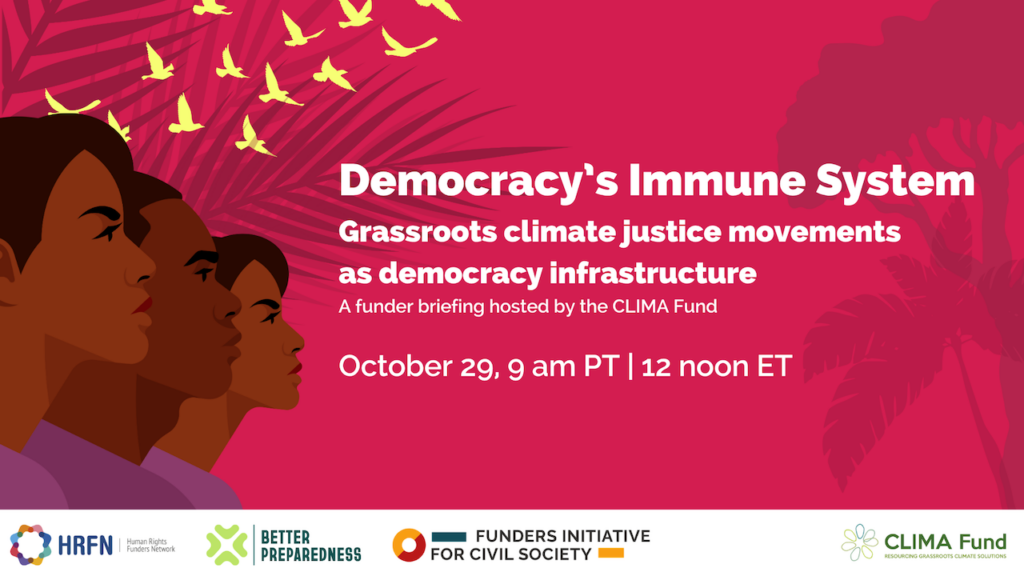
October 29, 9 am PT | 12 noon ET
Hosted by the CLIMA Fund
Co-sponsored by: Human Rights Funders Network, Funders Initiative for Civil Society, Better Preparedness Initiative, and the Open Society Foundations.
“There is no climate justice without the freedom to defend it, and no democracy without the protection of those who do.” – Maylott Mulugeta
We organized a funder briefing for our Democracy’s Immune System Initiative in October 2026. We are grateful to our speakers, Maylott Mulugeta, Zanele Sibanda, Omnia El Omrani, Mateo Martinez, and Salena Tramel, for sharing how grassroots climate justice movements are strengthening democratic participation while navigating ecological and political shocks.
Here are some takeaways from the call:
- Maylott (Urgent Action Fund for Feminist Activism) shared how attacks on environmental defenders can become a blueprint for suppressing all forms of democratic dissent. Reflecting on the Stop Cop City campaign in Atlanta, she explained how the same toolkit of surveillance, criminalization, and smear campaigns deployed against activists is also used against journalists, civil society organizations, and other opposition. She unpacked how climate justice movements are strategically positioned to protect democratic norms.
- Zanele (Thousand Currents) talked about how Indigenous women in the Philippines brought their organizing experience as land and rights defenders to the fight against election disinformation. Purple Action for Indigenous Women’s Rights (LILAK) trained young Indigenous women as community journalists to document and share what was happening in their territories. Their reporting was picked up by national media as the community journalists became a trusted source of information. Zanele explained why this work matters beyond elections: “the same disinformation that distorts an election also undermines a community’s ability to give or to withhold consent to a mine that is on their lands.” She concluded, “protecting forests, protecting water, and protecting the climate all depend on people having the truth, having a voice, and having real decision-making power.”
- Omnia (Youth Climate Justice Fund) highlighted how movements use research and evidence to hold corporations and governments accountable. She shared the work of RimbaWatch, a youth-led watchdog organization in Malaysia that turns complex environmental, spatial, and financial data into evidence for public use. After an oil company advertised one of its products as climate-neutral, RimbaWatch took the Consumer Protection Authority and Ministry of Environment to court. This was Malaysia’s first climate litigation case to challenge corporate greenwashing and government inaction.
- Salena (Grassroots International) shared: “a treaty alone won’t hold corporations accountable, but organized people will.” The Global Campaign to Reclaim Peoples’ Sovereignty, Dismantle Corporate Power and Stop Impunity is a campaign organizing 250 grassroots movements and cross-border networks to challenge corporate impunity, bringing a binding UN treaty on business and human rights to the negotiating table. Salena explained, “corporate power crosses borders, so does the organizing of social movements. The global campaign shows what that convergence looks like at scale. A strong treaty is one more way that movements are building power that lasts.”
- Mateo (Global Greengrants) explained: “Grassroots movements aren’t operating outside of democracy; they are helping create and defend it. Movements win environmental protections, they transform law and institutions, and over time, they can create a civic society that is increasingly willing to defend those institutions when they come under pressure.” Mateo reflected on over a decade of grassroots organizing in Ecuador to keep oil in the ground and protect the Yasuní National Park. Securing a referendum on the issue was only part of the struggle. Movements continue to monitor implementation and defend the constitutional protections that make environmental victories possible. “Durability isn’t simply whether a forest is protected today. It is also whether people have the institutions, the rights, and collective power to defend that forest tomorrow.”
You can find the call recording on YouTube. Please find an article about the initiative in Alliance Magazine here and an infographic with more information about the initiative here. We are grateful for the support of our co-sponsors Human Rights Funders Network, Funders Initiative for Civil Society, Better Preparedness Initiative, and the Open Society Foundations.
To read more about movements, climate, and democracy, please see the CLIMA Fund brief “Why Grassroots Climate Justice Movements are Critical for Defending Democracy”. Please have a look at Shifting the Momentum: Reclaiming Civic Space for Climate Mitigation by Funders Initiative for Civil Society. The Shifting the Momentum series seeks to assist climate donors to understand shrinking civic space in the climate policy and advocacy field, and, for those who are ready, to support efforts to reverse the trend.
